Several commands display standard file selection dialog boxes, in which you can navigate through local and network drives and through FTP sites and Web folders to select files. While each dialog box may vary slightly, following is a list of the possible options.
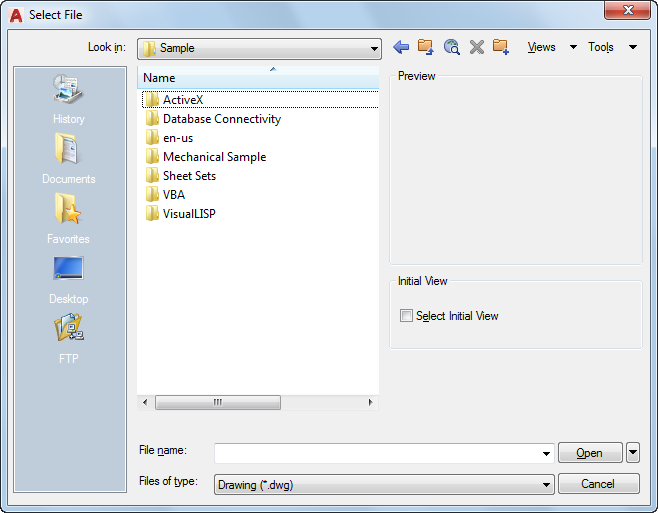
List of Options
The following options are displayed.
Places List
Provides quick access to predefined locations. Reorder the icons in the Places list by dragging them to a new position. To add a new icon to Places, drag a folder from the list. Changes to Places affect all standard file selection dialog boxes.
- History
Displays shortcuts to the files most recently accessed from the dialog box. It is recommended that you periodically remove unwanted shortcuts from the History list. Select History, then select the unwanted shortcuts in the Files list and click Delete. To sort the shortcuts by date, click Views
 Details, and then click the Modified column in the Files list.
- Personal/My Documents
- Favorites
- FTP
- Desktop
Look In/Save In
Displays the current folder or drive. Click the arrow to view the hierarchy of the folder path and to navigate up the path tree or to other drives, network connections, FTP locations, or web folders (either Web Folders or My Network Places, depending on the version of your operating system). You can create web folders in Windows Explorer. Consult your system administrator or Windows Explorer Help for more information about web folders. To control whether the last used paths in each particular standard file selection dialog box are stored across sessions, use the REMEMBERFOLDERS system variable.
Search the Web
Displays the Browse the Web dialog box, from which you can access and store files on the Internet.
Views
Controls the appearance of the Files list or Folders list and, for a Files list, specifies whether to show a preview image when a file is selected.
Tools
Provides tools to help with file selection and other actions available in file selection dialog boxes.
Files List
Displays the files and folders in the current path and of the selected file type. Use the Views menu in the dialog box to switch between List view and Details view.
Preview
Displays a bitmap of the selected file when you choose Views Preview in the dialog box. To save a bitmap with a drawing file, use the Save a Thumbnail Preview Image option on the Open and Save tab in the Options dialog box.
File Name
Displays the name of the file you select in the Files list. If you select multiple files, File Name displays each selected file within quotation marks. You must use quotation marks when entering multiple file names. You can use wild-card characters to filter files displayed in the Files list.
Files of Type
When you are saving files, Files of Type specifies the format in which the file is saved.
Select Initial View
Displays the specified model space view when you open the drawing if the drawing contains more than one named view.
Update Sheet and View Thumbnails Now
Reflects the current setting of the UPDATETHUMBNAIL system variable. This option temporarily overrides, but does not change the current setting of UPDATETHUMBNAIL.
Open/Save
Depending on the purpose of the specific file selection dialog box, opens or saves the selected file or enters the path of the selected folder in the previous dialog box. Certain file selection dialog boxes may include additional options, accessed by clicking the arrow next to the Open button.